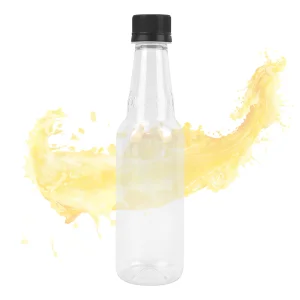
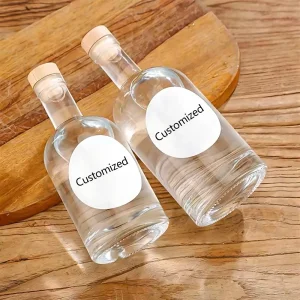
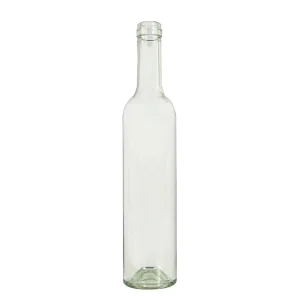
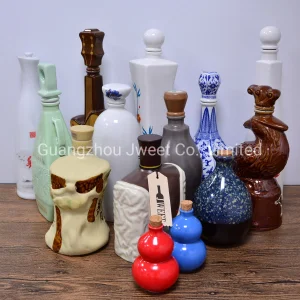
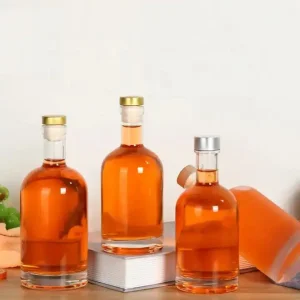
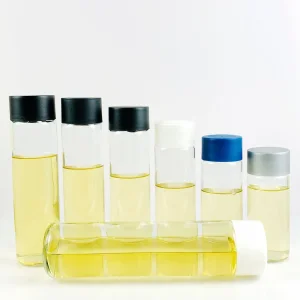
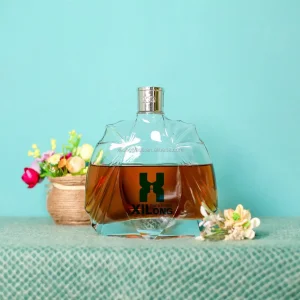
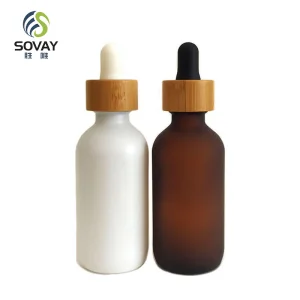
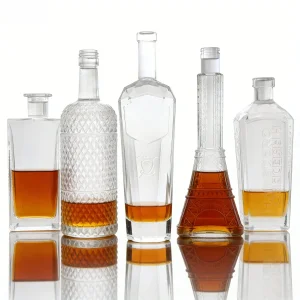
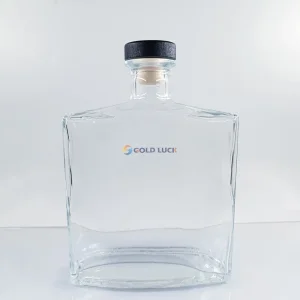
Explore our highly curated selection of flint and specialty glass bottles designed for high-end cosmetics, premium spirits, and food preservation.
In global packaging engineering, flint glass (often designated as soda-lime-silica glass) represents the pinnacle of optical clarity and chemical durability. Standard glass compositions typically contain impurities—most notably iron oxides (Fe2O3)—which impart a green or amber tint. To achieve the coveted "Super Flint" or "Extra Flint" grade, manufacturers must source silica sand with an iron content of less than 0.015%.
Furthermore, decolorizing agents like selenium, cobalt oxide, or neodymium are precisely dosed in parts-per-million (ppm) to neutralize any remaining wavelengths of light. This level of purity ensures a high refractive index and light transmission exceeding 92%, making it the ideal medium for displaying the natural colors of premium spirits, cosmetics, and fine foods. The mechanical stability of flint glass also allows for structural innovations like thick-base engineering, which shifts the center of gravity downward, providing a premium weight and feel.
Global procurement directors evaluate suppliers based on a strict matrix of operational parameters. The search for a reliable manufacturing partner goes beyond basic pricing; it requires deep audits of engineering capabilities and systemic quality control.
| Assessment Vector | Industry Baseline Requirements | Super Flint / Premium Class Benchmarks |
|---|---|---|
| Fe2O3 Concentration | < 0.05% (Standard Flint) | < 0.015% (Extra/Super Flint) |
| Forming Precision (Tolerances) | ± 1.5% on capacity and outer dimensions | ± 0.5% (Critical for automatic filling lines) |
| Annealing Index (Residual Stress) | Real Tempered Class 3 (ASTM C148) | Class 1 to Class 2 (Optical grade polarization) |
| Post-Processing Capability | Basic labeling and single-color screen print | Multi-axis decal firing, acid frosting, hot-stamping, electrostatic spraying |
When selecting the top 10 flint glass suppliers globally, buyers prioritize vertical integration. High-performing factories possess in-house mold design and manufacturing labs (using advanced CAD/CAM software), which reduce development lead times from months to weeks. Additionally, automated optical inspection (AOI) lines at the cold end are non-negotiable for high-speed filling lines where cosmetic defects like seeds, blisters, or checks can lead to catastrophic line failures.
How industry-leading factories are leveraging automation, material science, and sustainability to redefine high-purity glass manufacturing.
Narrow Neck Press and Blow (NNPB) technology allows the reduction of wall thickness while maintaining structural integrity. By optimizing material distribution, factories achieve up to 30% reduction in bottle weight, significantly lowering shipping costs and carbon footprints.
Advanced factories integrate automated cameras and laser sensors (Cold End AOI) at the exit of the annealing lehr. These AI-driven systems run real-time checks on neck diameter, thread alignment, base thickness, and micro-cracks, instantly rejecting defective items.
To meet ESG criteria, forward-looking suppliers are transitioning from heavy oil furnaces to gas-oxygen and hybrid electric-boosting furnaces. This reduces direct CO2, SOx, and NOx emissions by up to 40% while enhancing temperature control consistency.
The Pearl River Delta and Yangtze River Delta clusters in China remain the global heart of premium glass container manufacturing. The competitive advantage of Chinese glass factories is not merely based on labor cost, but rather on unparalleled supply chain integration.
Within a 50-kilometer radius, factories have direct access to high-precision mold makers, specialized raw material refining facilities, auxiliary component suppliers (screws, pumps, natural corks, Guala caps), and global shipping ports like Shenzhen and Guangzhou. This geographic density enables rapid prototyping (completing custom physical samples within 15–20 days) and minimizes intermediate transit times. For global brands managing tight launch timelines, this agility mitigates market risks and ensures reliable inventory pipelines.
A Proven Track Record of Excellence, Quality-First Operations, and Sustainable Infrastructure
Dongguan Swapora Bottle Co., Ltd. established in 2022, originated from a dream of bringing high-quality Chinese glass products to the global market. Starting as a small processing plant focused on the domestic market, we have gradually grown and expanded through our dedication to quality and pursuit of innovation.
Our integration of design engineering with high-performance manufacturing ensures that we deliver products that meet the highest standards of international markets. Our design department utilizes advanced CAD/CAM processes to model customized bottle shapes, conducting structural analysis to eliminate stress points before the physical mold is cast. This rigorous engineering cycle guarantees that our bottles perform flawlessly under high internal pressure and temperature transitions during pasteurization or hot-fill processes.

Our production base is located in an industrial park in Guangdong Province, covering a total area of 10,000 square meters, with over 6,000 square meters of modern standard factory buildings. The factory integrates glass melting, deep processing, warehousing, and logistics, ensuring efficient and continuous production processes.
The factory area is scientifically planned, clean, and equipped with advanced environmental protection systems, reflecting our green manufacturing philosophy. Our production workshops strictly adhere to the 6S management system, providing a clean and orderly environment for the precision manufacturing of every piece of glass. By maintaining clean-room standards around our cold-end processing areas, we prevent particulate contamination, ensuring that cosmetic-grade and food-contact glass containers are ready for immediate filling upon arrival at customer facilities.
Quantifying our commitment to scalability, reliability, and precision engineering.
Different industry sectors require tailored chemical properties and post-processing treatments. We provide specialized solutions across three primary verticals:
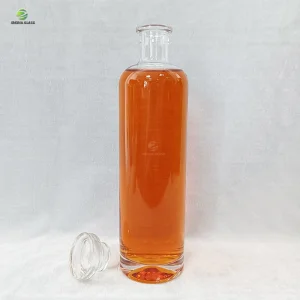
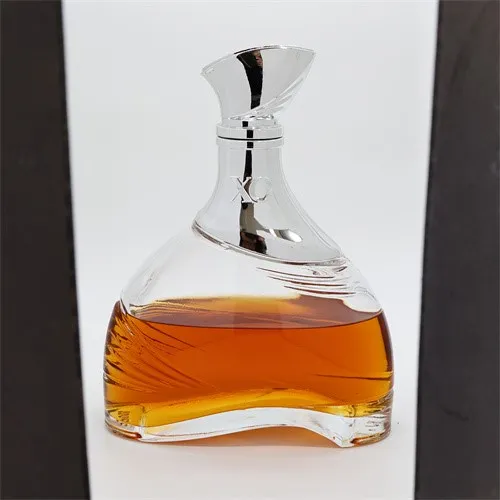
The spirits segment requires bottles with exceptional optical clarity to showcase the clarity of the liquid, along with thick bases for stability and high impact resistance. To prevent internal stress points, our bottles undergo precise thermal profiles in the annealing lehr. Deep post-processing options include high-fire ceramic decals, direct screen printing with precious metals, acid etching for a frosted look, and custom embossing to reinforce brand identity.
Cosmetic packaging must protect formulations from ultraviolet degradation while maintaining an elegant aesthetic. Our cosmetic droppers, amber bottles, and frosted containers are engineered for chemical resistance (USP Type III hydrolytic resistance), preventing leaching and interactions between the packaging material and active cosmetic compounds.
For food applications, our flint jars are designed to withstand thermal shock differentials of up to 42°C (107°F), making them suitable for hot-filling, pasteurization, and vacuum sealing. The glass is certified non-toxic, odorless, and completely free of lead and heavy metals, meeting food safety standards worldwide.
Exporting to highly regulated markets like North America and the European Union requires consistent quality standards. Top-tier manufacturers implement a multi-stage Quality Assurance (QA) protocol from raw materials to final shipping:
Technical and logistics questions answered by our material scientists and supply chain experts.
The primary differences lie in raw material purity and visual properties. Super Flint glass uses high-purity silica sand with exceptionally low iron levels (under 0.015% Fe2O3) and optical decolorization agents. This results in a clear, colorless glass with high light transmission and refraction. Standard Flint glass, while still clear, can have a slight green or blue tint due to higher trace iron content and is typically used for standard food jars and lower-cost beverage bottles.
Yes. Our flint glass containers are engineered to handle standard hot filling and pasteurization processes. They are designed to withstand a thermal shock differential (ΔT) of 40°C to 42°C without breaking. For products requiring retort sterilization (above 120°C / 248°F), we can customize the glass composition and wall thickness to meet the required pressure and temperature profiles.
For custom container designs, the timeline generally follows this structure: initial 3D digital renderings are generated in 3–5 working days; sample molds and test physical samples are prepared within 15–20 days; upon approval, production molds are completed in 15 days, followed by mass production which usually takes 25–35 days, depending on quantity and order backlog.
All our raw materials undergo periodic heavy-metal testing via inductively coupled plasma mass spectrometry (ICP-MS) to ensure compliance. We provide full FDA food-contact compatibility certifications, EU Food Grade compliance documents, and California Proposition 65 test certifications upon request.
Explore our technical-grade flint glass bottles, including customized high-capacity spirits containers, eco-friendly models, and apothecary packaging.
 Swapora Bottle